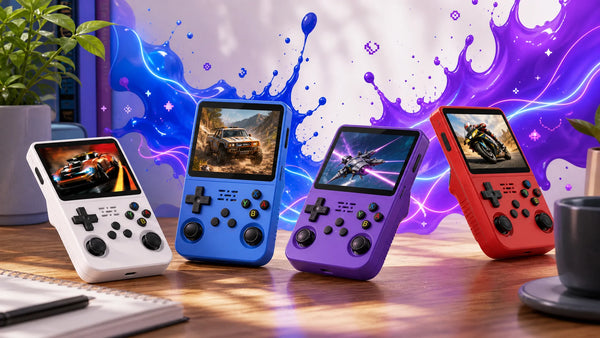
This portable retro gaming console comparison helps you choose by budget, format, and emulation level—without naming brands, based on concrete criteria. We compare what truly matters: what the console can do, its battery life, and its comfort.
The criteria that make the difference
- Emulation: how high does it go (8/16-bit, PS1, N64, PSP)?
- Screen: IPS or OLED, size, 4:3 ratio.
- Battery life: mAh and actual hours.
- Format: pocket, controller, clamshell.
- System: muOS, OnionOS, Knulli.
Comparison by budget
Entry-level (€35–60) — Smooth 8/16-bit, decent IPS screen, 4–6 hours battery life. Ideal for beginners.
Mid-range (€60–120) — PS1 and N64, better screen, 6–8 hours. The king of value for money.
Premium (€150+) — PSP, Dreamcast, OLED, 8–10 hours, refined finishes.
Comparison by format
Pocket offers more mobility, controller offers more comfort, clamshell offers more protection. For equal power, choose based on where you'll play most often.
How to read our product sheets
Each product sheet indicates the emulated systems and their compatibility level (perfect / very good / limited), measured battery life, and screen type. No marketing promises: tested data.
Our selection
Find all compared models in our portable retro gaming consoles. For playing on TV rather than on the go, see the multi-game arcade plug-and-play systems.
FAQ — Portable Console Comparison
Which is the best in the comparison?
There's no universal winner: the best depends on your budget and the games you want to play. The mid-range offers the best compromise.
Should I prioritize OLED?
OLED enhances PS1/N64 games, but a good IPS is sufficient for 2D and costs less.
Are they all plug & play?
Yes: preloaded SD card, emulator ready, no configuration required.