Which retro handheld game console is best in 2026? 14 models compared on concrete criteria — screen, chip, emulation reach, battery and price.
The best retro handheld game console is the one that reaches the systems you actually want to play. For 8- and 16-bit — NES, Super Nintendo, Mega Drive, Game Boy and Game Boy Advance — a 3.5″ pocket model is enough. For PlayStation 1 and Nintendo 64 you want a 4″ IPS screen and real analog sticks. For PSP and Dreamcast, a 5″ or larger screen and a faster chip. The table further down compares 14 handhelds on screen, chip, system, storage, battery and price.
Comparing retro gaming consoles isn't about lining up numbers: it's about looking at what they can actually do. This guide sorts handhelds by budget, format and emulation level, on concrete, verifiable criteria — not marketing claims.
The criteria that make the difference
Five points separate a good handheld from a forgettable one: how far emulation goes (from 2D to the PS2), screen quality (IPS or OLED, 4:3 ratio), the presence of analog sticks — decisive the moment you hit 3D — real battery life versus the advertised mAh, and the simplicity of the system (ArkOS, muOS, OnionOS). The rest is detail.
How should you weigh these criteria? It all depends on your games. For pure 2D, emulation and sticks take a back seat: you choose on screen, battery and format. The moment 3D enters the picture (PS1, N64, PSP), the order flips: power and analog-stick quality become the priority, with screen and battery following. The classic trap? Comparing two consoles on the processor alone while ignoring the sticks or the screen: on paper one wins, in the hand the other delivers a far better experience. The spec sheet only tells part of the story.

Comparison by tier
| Tier | What it can run | Who it's for |
|---|---|---|
| Entry-level | NES, Super Nintendo, Game Boy, GBA, Mega Drive | Starting out, gifting, 2D |
| Mid-range | Plus the PS1 and most N64 games | The best all-round compromise |
| Premium | Plus PSP, Dreamcast, sometimes PS2 and GameCube | Demanding players |
In plain terms: entry-level handles 2D without flinching — start with the R36S 3.5″ or browse the affordable selection. Mid-range unlocks the PS1 and most of the N64, with the R36 Ultra 4″ WiFi as the value benchmark. Premium reaches the PSP, the Dreamcast, sometimes the PS2, like the H55 5.5″ or the very muscular M28 7.1″.
Within each tier, the right choice depends on format as much as power. At entry-level, favour a well-finished model with a real IPS screen over the cheapest of the bunch. Mid-range is the tier where value for money is densest: smooth PS1, a good screen and decent battery without blowing the budget — that's where most of our best-sellers sit. At premium, you no longer pay so much for power as for comfort: big screen, finish, XXL battery and emulation of the heaviest systems. Moving up makes sense if your games justify it, not on principle.
Comparison by format
At equal power, the pocket wins on mobility, the controller on comfort, the big screen on readability (ideal for 3D) and the plug-TV on conviviality. Choose by where you'll play most: that's what you really feel day to day, far more than half a gigahertz of difference.
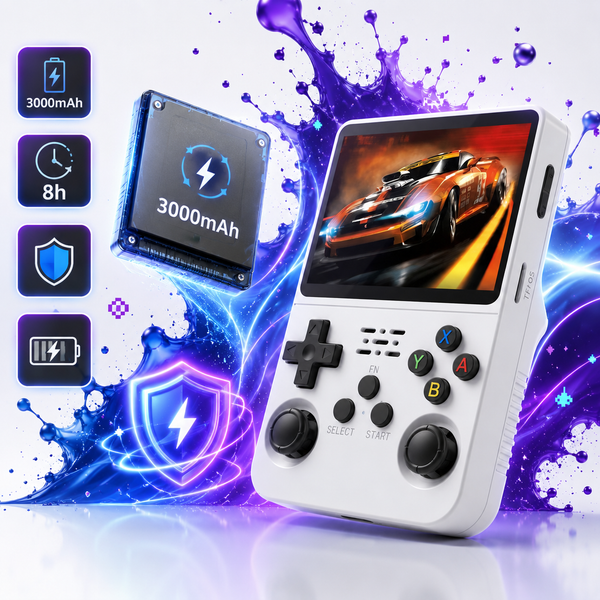
Battery life, too, depends on format and use. A small pocket model, with a smaller screen and a frugal chip, often lasts longer than a power-hungry big screen at comparable power. For daily commutes, an enduring pocket format wins; for relaxed sessions at home, a big screen you recharge now and then makes battery a non-issue. Think about charging too: USB-C has become the norm, letting you use the same cable as your phone — a handy little detail day to day.
How to read our product pages
Each page lists the emulated systems and their compatibility level (perfect / very good / limited), the battery life, the screen type and the installed system. No empty superlatives: concrete data to compare with confidence, and compatibility stated system by system rather than a vague "compatible".
To make this concrete, a typical example: you're torn between entry-level and mid-range. If your game list stops at the Super Nintendo and the Game Boy Advance, entry-level is enough and you save money. If it contains even two or three PS1 or N64 titles you really want to finish, mid-range spares you the frustration. It's almost always the presence — or absence — of 3D games in your list that decides, far more than design or colour.
Our selection
Every model compared is gathered in our retro gaming handheld consoles. To play on the TV rather than on the go, see the plug-TV sticks and cabinets. And if you want us to name a winner for your profile, the quiz does it in a minute, or let our best retro gaming console guide walk you through it.
In the end, remember one thing: there's no "best" console in absolute terms, only a best console for your use. It all comes down to crossing your games (2D or 3D?), your format (pocket, controller, big screen, TV) and your emulation tier. Once these three axes are set, two or three models naturally stand out — and that's where our product pages, with system-by-system compatibility, decide. No superlatives: criteria, your game list and common sense.
FAQ — Best retro handheld game console
What is the best retro handheld game console?
There is no single winner — it depends on the systems you want to run. A 3.5″ entry-level handheld covers 8- and 16-bit. A 4″ IPS model with analog sticks is the sweet spot: it adds the PlayStation 1 and most of the Nintendo 64 library. A 5″ or larger model with a faster chip is what you need for the PSP and the Dreamcast. For most players the mid-range 4″ tier is the best buy.
Should I favour OLED?
OLED elevates PS1/N64 games, but a good IPS is enough for 2D and costs noticeably less.
Are analog sticks really important?
For 2D, no. For 3D (N64, PSP), yes: it's even the first thing to check.
Are they all plug & play?
Yes: preloaded SD card, emulator ready, no setup.
Should I always get the newest model?
Not necessarily. Retro games don't change: a slightly older but well-finished console stays excellent. Compare real capabilities, not the release year.
Is the advertised game count a good criterion?
No. An inflated counter often hides duplicates and games that crash. A clean, well-sorted library beats a marketing number.
How do I compare battery life honestly?
Look at battery life for the kind of game you'll actually play: a figure measured on 2D doesn't reflect a more demanding PS1 session.
The concrete 3D case: play PS1 games on a handheld.